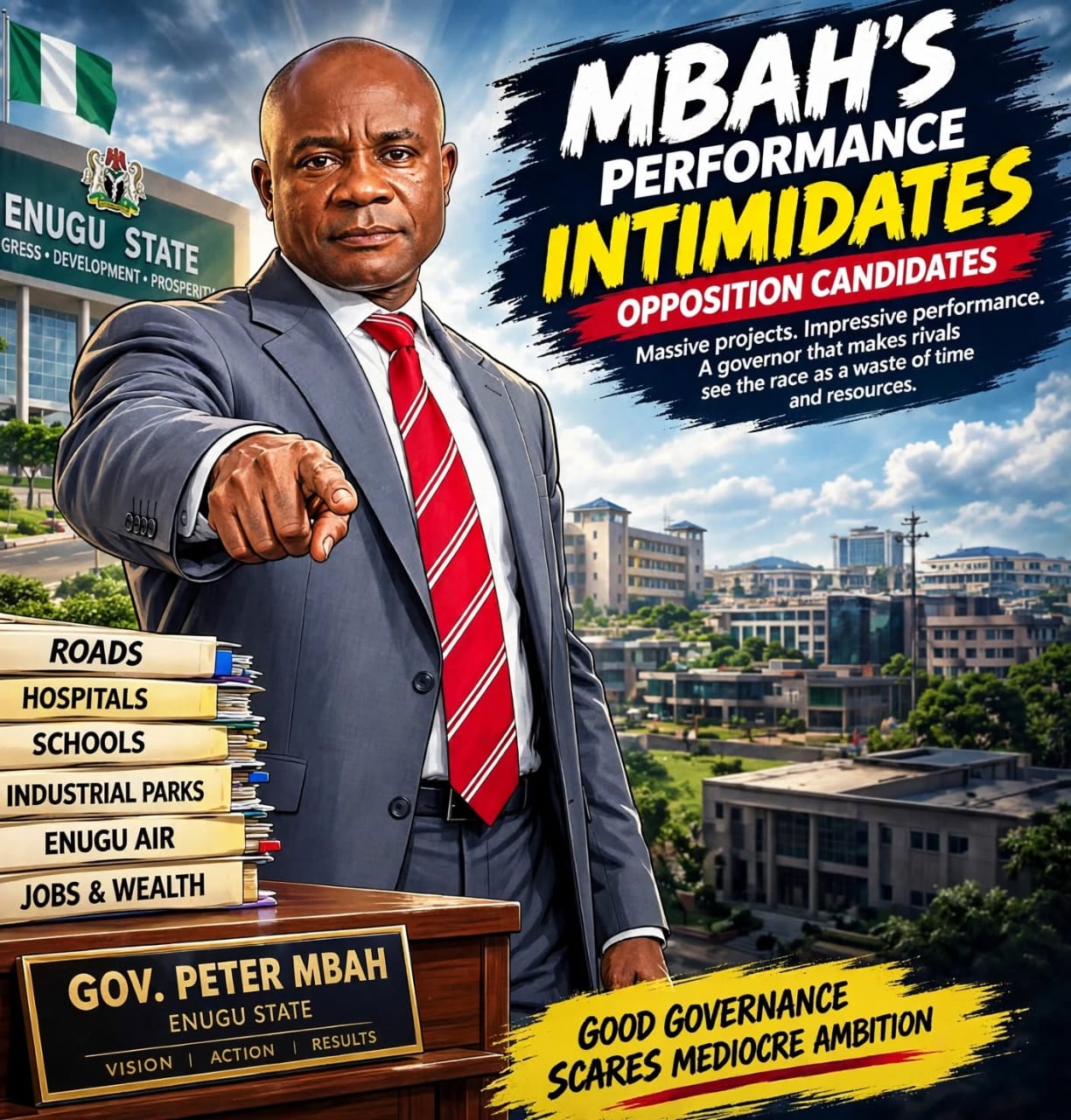
As endorsements pour in from traditional institutions, community leadership structures, and political stakeholders across party lines, Governor Peter Mbah’s administration is increasingly defining political discourse in Enugu State around governance, infrastructure, economic transformation, and measurable development outcomes rather than partisan rhetoric.
In every democracy, opposition parties play a vital role by scrutinizing government policies and offering alternative visions.
However, opposition politics is most effective when it is anchored on facts, constructive criticism, and viable alternatives. In Enugu State today, the challenge facing political opponents is no longer how to gain attention, but how to present a development agenda that convincingly surpasses the ambitious transformation currently underway under Governor Peter Ndubuisi Mbah.
Since assuming office in 2023, Mbah has pursued an aggressive modernization agenda aimed at repositioning Enugu as a leading destination for investment, innovation, tourism, and private sector-driven economic growth. His administration’s overarching target of expanding the state’s economy from approximately $4.4 billion to $30 billion within eight years has become the central framework guiding government policies and public investments.
A Growing Coalition of Support:
Recent months have witnessed an unprecedented convergence of support around the governor’s administration.
In a symbolic demonstration of confidence, Ohanaeze Ndigbo in Enugu State presented the revered Ofo, the traditional symbol of justice, authority, and moral legitimacy, to Governor Mbah at Michael Okpara Square while endorsing his leadership and development agenda.
Similarly, the Council of Presidents-General representing the state’s 583 autonomous communities publicly adopted the governor for a second term, citing the administration’s ward-based development strategy and extensive grassroots interventions across rural and urban communities.
The endorsements have extended beyond traditional institutions into the political arena. Several notable figures who have shaped the state’s political history, including former Senate President Ken Nnamani, former governors Jim Nwodo, Okwesilieze Nwodo, Sullivan Chime, and Ifeanyi Ugwuanyi, have all expressed varying degrees of support for the administration’s development trajectory.
Equally significant is the backing of respected technocrats and business leaders, including former Minister of Power Prof. Bart Nnaji and industrialist Capt. Evarest Nnaji, reflecting a broad consensus around the state’s economic transformation agenda.
Development as the Political Battleground:
What distinguishes the current political climate in Enugu is the visibility of ongoing projects across multiple sectors. The administration’s record includes extensive road construction and rehabilitation projects linking urban and rural communities, the establishment of Smart Green Schools across the state’s wards, significant investments in primary healthcare infrastructure, expanded water supply projects, and digital governance initiatives designed to improve service delivery.
The state has also accelerated work on strategic economic projects such as the New Enugu City development initiative, agricultural value-chain investments, transport infrastructure upgrades, and efforts to enhance the state’s attractiveness to both domestic and international investors. Perhaps most notably, the government’s focus on education, healthcare, security, and technology reflects contemporary global best practices in subnational governance, where competitiveness is increasingly measured by human capital development and the ability to attract investment rather than solely by political affiliations.
Why the Opposition Faces a Difficult Challenge:
The reality of electoral politics is that opposition parties perform best when public dissatisfaction is widespread or when incumbents struggle to demonstrate visible achievements.
In Enugu, however, the political conversation has increasingly shifted toward performance metrics, project implementation, and economic outcomes. This does not mean criticism of government is unwarranted. Questions surrounding project costs, sustainability, revenue generation, debt management, transparency, and long-term economic impact remain legitimate areas for public scrutiny.
However, political observers note that any serious challenger must now do more than criticize government policies. The electorate is increasingly demanding credible alternatives and concrete solutions.
For opposition parties, the burden is therefore higher. They must not only identify gaps in governance but also articulate how they would deliver superior outcomes in education, infrastructure, healthcare, economic development, security, and youth employment.
Recent Developments Strengthening Enugu’s Profile:
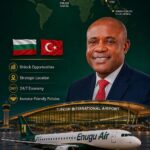
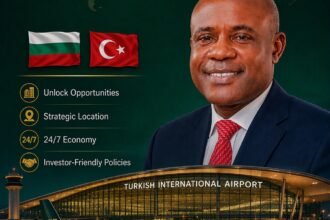
Recent developments continue to reinforce Enugu’s growing profile as one of Nigeria’s emerging investment destinations.
The administration has intensified efforts to expand transport and aviation infrastructure, attract private capital into key sectors, modernize public services through technology, and create a business-friendly environment aimed at stimulating enterprise growth.
The government’s emphasis on Smart Schools, upgraded healthcare centres, digital land administration, urban renewal projects, and youth-focused economic initiatives aligns with global development trends that prioritize knowledge economies, innovation ecosystems, and sustainable urban planning. These reforms are designed not merely as government projects but as foundational investments intended to drive long-term economic competitiveness and improve the quality of life for residents.
A New Political Reality:
As Enugu moves closer to the 2027 electoral cycle, one reality appears increasingly evident: governance performance has become the principal currency of political relevance.
Governor Peter Mbah’s greatest political advantage may not be incumbency or party affiliation, but his administration’s decision to make development outcomes the centrepiece of governance.
The implication for opposition parties is clear. If they hope to persuade voters, they must engage on the terrain that has already been established: measurable results, economic transformation, job creation, human capital development, and the future prosperity of Enugu State.
Political competition remains essential to democracy.
However, in Enugu today, that competition is increasingly being defined not by slogans or partisan rhetoric, but by a fundamental question:
Who can present the most compelling vision for sustaining and accelerating the state’s ongoing transformation?
If current trends continue, the 2027 governorship election may ultimately be remembered not as a contest of political personalities, but as a referendum on development, performance, and the future direction of Enugu State.
Let’s unite for the future of Enugu State beyond 2027.
A new Enugu State is possible with Governor Peter Ndubuisi Mbah.
Invest in Enugu. Invest in the Future. Enugu is open for business. Build in the South-East Economic Superhighway – Accelerating Trade, Investment and Regional Development.
Office of the Special Adviser to the Governor of Enugu State on Investment Strategy and Public Relations, Prince Humphrey Onyima, Government House Enugu, Nigeria.
12th September, 2026.