
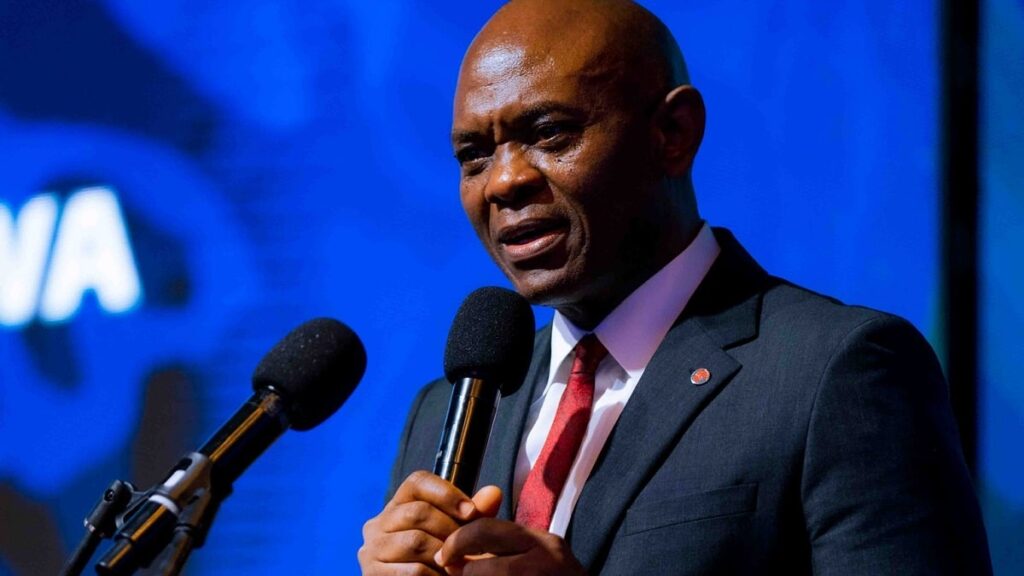
United Bank for Africa (UBA) has been unable to pursue expansion into Ethiopia and Angola because of the Central Bank of Nigeria’s (CBN) regulation limiting banks’ investments in foreign subsidiaries to 10% of their shareholders’ funds, its chairman Tony Elumelu has said.
Elumelu disclosed this on Saturday at the launch of a book by Nigerian lawyer Wole Olanipekun, where he discussed the impact of the CBN’s regulatory policies on the bank’s international expansion.
He said UBA had hoped to become the first international bank to establish operations in Ethiopia following the country’s decision to open its banking sector to foreign investors but could not proceed because of the capital restriction.
“We wanted to be the first bank in the world to operate in Ethiopia, now that they opened the economy. Mr Cardoso said we have a policy that says 10% of capital; you can’t invest more than 10% of capital in foreign subsidiaries,” Elumelu said.
“Painful as it was, we listened, we complied, because it’s the same principle, same policy across the board.”
He added that the same restriction had prevented the bank from entering Angola.
“You know the same thing in Angola. We wanted to go to Angola; we can’t, but we respect it,” he said.
What CBN’s 10% foreign investment rule says
The restriction is contained in Section 19(8)(c) of Nigeria’s Banks and Other Financial Institutions Act (BOFIA) 2020, which limits a bank’s aggregate investment in foreign subsidiaries to 10% of its shareholders’ funds unimpaired by losses, unless the CBN approves a different threshold.
The central bank has stepped up enforcement of the provision as Nigerian lenders complete a recapitalisation exercise and seek to strengthen their balance sheets.
In September, the CBN said the restriction was intended to prevent excessive exposure to offshore businesses from threatening the stability of domestic banks.
Olubukola Akinwunmi, the CBN’s Director of Banking Supervision, said the regulator was enforcing an existing law rather than introducing a new restriction on international expansion.
The enforcement has also affected other Nigerian lenders.
Access Holdings, for instance, is considering selling stakes in some foreign subsidiaries or exiting at least one market to bring its offshore investments within the regulatory threshold.
UBA defends compliance with regulatory rules
Despite the restrictions on its expansion plans, Elumelu said he supported the CBN’s approach, arguing that consistent application of regulations was important for building investor confidence.
He said businesses could accept difficult regulatory decisions more easily when the same rules applied to every institution, regardless of its size or influence.
“It becomes painful to an entrepreneur if the rules are different for different people,” he said.
Elumelu also praised CBN Governor Yemi Cardoso for enforcing regulatory requirements consistently, saying the approach had helped attract capital into Nigeria.
UBA already operates across more than 20 African countries, alongside international markets in Europe and the United States. Its expansion has made it one of Nigeria’s largest cross-border banking groups.
The bank’s inability to enter Ethiopia and Angola highlights the tension between Nigerian lenders’ ambitions to expand across Africa and the regulator’s efforts to limit the amount of domestic banking capital exposed to foreign operations.