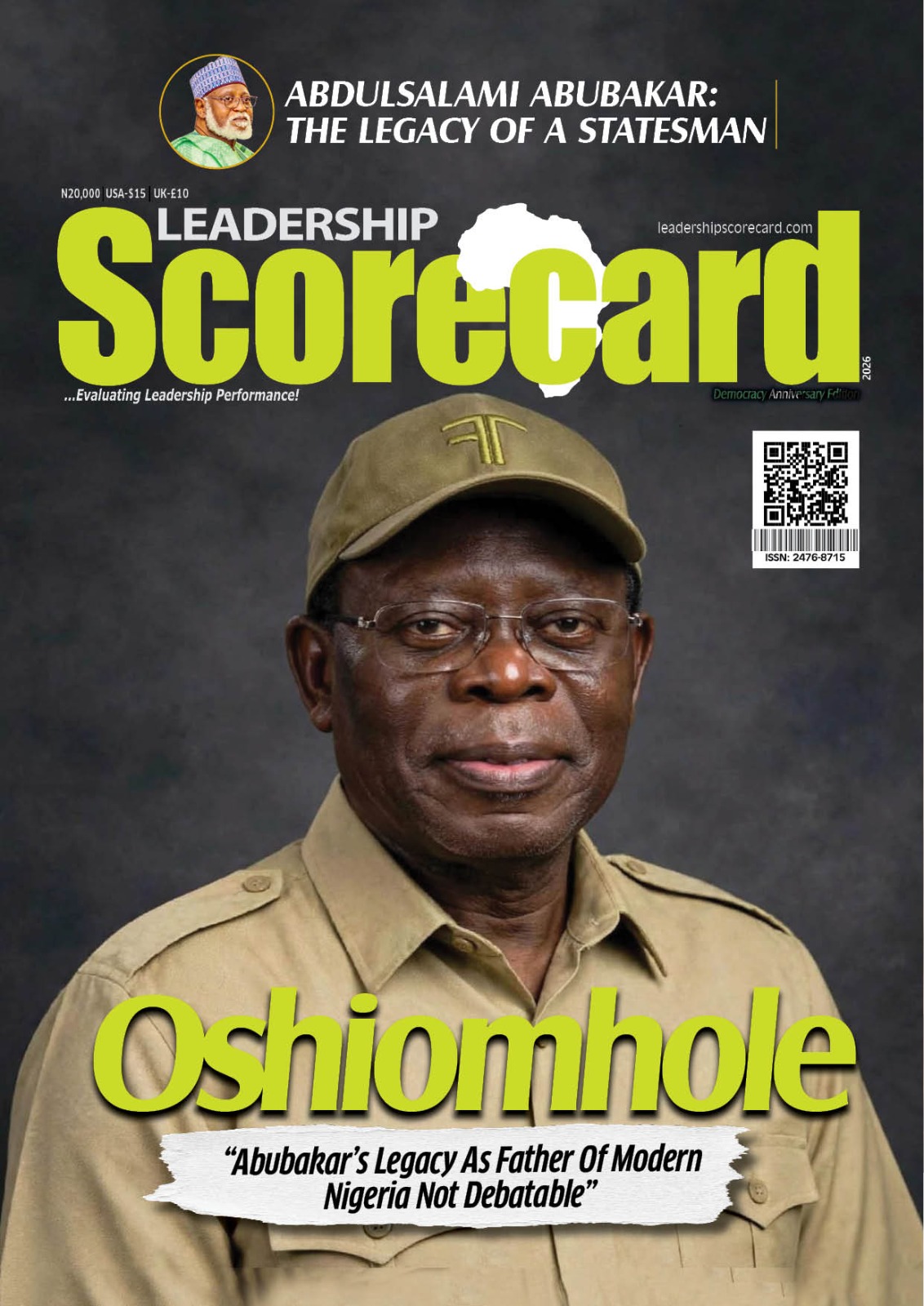
Adams Oshiomhole is a former president of the Nigeria Labour Congress, former governor of Edo State, and former national chairman of the All Progressives Congress (APC). As part of a series of tributes to General Abdulsalami Abubakar (Rtd.), the military head of state who oversaw Nigeria’s transition to civilian rule in 1999, Oshiomhole spoke on the former leader’s brief but consequential 11 months in office, his handling of the 1998 elections, and the enduring lessons of his exit from power.
In this instalment of our series honouring former Head of State General Abdulsalami Abubakar, who midwifed Nigeria’s return to democracy in 1999, how would you describe the political atmosphere in 1998 when he assumed office?
It was a tense and painful period for Nigeria. General Abubakar came in during the transition arrangement put in place by General Ibrahim Babangida, a process that had dragged on for years through primaries and elections whose results were ultimately annulled. An interim government was then installed under Ernest Shonekan, but it was widely seen as unconstitutional — neither backed by law nor properly a government of a head of state or president. Nobody was certain whether it was a stopgap for General Sani Abacha to seize power or a stopgap towards fresh elections, and that uncertainty kept the country on edge.
As a trade union activist at the time, Abdulsalami was not considered among the political heavyweights, who included men like General Jeremiah Useni and Senator David Mark. It was under that tense atmosphere that Abacha died. During his rule, he had detained anyone he saw as a threat, including Chief Olusegun Obasanjo, Shehu Musa Yar’Adua, and several labour leaders, me included. He proscribed the Nigeria Labour Congress, where I served as deputy president, and enacted decrees barring a sitting general secretary from contesting for president. We amended our own rules in response, and I eventually resigned my employment to remain eligible to contest.
It was in these circumstances that Abacha died and General Abdulsalami Abubakar was installed to hand over to a democratically elected government. To achieve that, he needed to create an atmosphere in which people felt free to speak. One of his first acts was to repeal the decree that had dissolved the NLC, and it was under those new conditions that I became NLC president. He also released detained labour leaders such as Frank Kokori and, without anyone even asking, began releasing political prisoners. A society that had been under enormous stress gradually loosened up, and people started speaking freely again.
Having seen other military leaders fail at midwifing democracy, how did Abubakar earn the trust of both military and political leaders?
It is not difficult to explain. The moment he began reversing the injustices of his predecessor, such as restoring the rights of trade unions to elect their own leaders, it became clear the man meant well. Democracy is not only about the right to contest elections. It is also about the freedom of citizens to form organisations in pursuit of shared goals, and the trade union movement is one of the most visible examples of that. His release of political detainees, some of whom had spent years in prison, was further proof of his intentions.
I recall reading his account of how the constitutional review was approached. Rather than start from zero, he examined what already existed, what could be amended, and what could remain. Even though I had been proscribed under Abacha, he understood why, and he went on to nominate me to the coordinating committee overseeing the constitutional review, chaired by the late Justice Niki Tobi. He did not invite my then boss, Pascal Bafyau, who was NLC president at the time, but he invited me, even though I had no personal relationship with him. Our task was to modify the 1979 constitution, which had already moved Nigeria from a parliamentary system to a presidential system under the Shagari administration, so that it could serve the incoming democratic government. Rather than reopen the fundamental debate over parliamentary versus presidential systems, we simply rebalanced what Nigerians had already agreed on. We travelled to every state to gather input, so when people call the constitution fraudulent, I would point out that it was reviewed by Nigerians, not foreigners.
How would you describe Abubakar’s use of power compared with that of his predecessors?
The difference is that Abubakar recognised that society is better governed democratically, and that the business of the armed forces is to defend the territorial integrity of the nation, not to rule it. His predecessors treated the transition process as a means of prolonging their stay in office. He was genuinely convinced that Nigeria needed to return to democracy and did not believe an enabling environment required endless time to build.
I still maintain that the elections he conducted in 1998 were far fairer than those of 2003, which were ironically overseen by an elected President Obasanjo. I cannot recall anyone accusing Abubakar of manipulating the process or favouring a predetermined candidate. He may have had preferences, but whatever they were, they were pursued democratically. The diversity of Nigeria was reflected in the outcome, with different parties holding sway in different regions, which showed that the will of the people prevailed, despite the sporadic violence and use of thugs that still occurred. By the time the 2023 elections came around, it was clear that Abubakar had laid a foundation our electoral system has still not fully built upon.
Would Nigeria have evolved differently had Abubakar not allowed a democratic transition?
There could certainly have been problems. Considering the pressures within both the armed forces and the civilian population that forced Babangida to step aside, and the pressure Abacha had to exert to manage the military, Nigerians had reached a point where they no longer wanted military rule in any form. They simply wanted a system in which they could speak freely and elect or remove their leaders. Civil society and labour unions were united in demanding a return to democracy, and even Abacha, for all his ambitions, found the pressure uncomfortable. The external environment mattered too. The Cold War had ended, and there was growing international consensus on the need for democratisation across a continent still dominated by military rule. Nigeria could no longer be held together by force of arms.
As a former trade unionist who witnessed both the military and civilian economic eras, how would you compare them on issues such as privatisation, fiscal stabilisation, and the recovery of looted funds?
It is a dangerous comparison to make, because it risks suggesting that the military government can deliver prosperity. Under military rule, our liberties were frozen while the military looted the nation, and efforts to recover those loots continue even now. I would not draw a blanket comparison between the two systems, because the temptation to use the office for the benefit of one’s own family exists on both sides.
On privatisation specifically, I have mixed feelings, because not everything should be handed to private hands. Babangida began the process through the Technical Committee on Privatisation, and Obasanjo later established the National Council on Privatisation, with the Vice President as chairman and Nasir El-Rufai as founding director-general. Some transactions succeeded and others failed, including in the steel sector. The law required evidence of technical know-how before an entity could bid for a state enterprise, yet many assets ended up with cronies who had neither the expertise nor the capital to run them properly and bring in fresh investment.
The most glaring example was the privatisation of the power sector under President Jonathan. As governor at the time, I argued publicly that the process would ruin the sector, and in Edo State, the distribution company was handed to a pharmacist who made his wife deputy chairman, turning it into a family business. Dr. Emmanuel Uduaghan and I held a press conference to denounce the exercise, warning it would damage state economies. Today, the debts the distribution companies say they have borrowed from the Central Bank far exceed what they ever invested in the sector. I am not against private capital, but it must be deployed with proper ethics and accountability, because the market can consume anyone who enters it carelessly. We need a radical review of the power sector, and I am hopeful the current Minister of Power can think differently about achieving reliable electricity supply, which remains a precondition for sustainable growth.
How would you assess the Abubakar’s legacy on peace, conflict resolution, and democracy?
The most important lesson is the power of example. Abubakar has shown that you do not need to be in government to command respect or to speak truth to power. Today, alongside General Yakubu Gowon, he is one of the few Nigerians who can tell those in power when they are wrong and be heard. He has earned that right by showing that impact matters more than tenure. In 11 months, he achieved what the military establishment could not in over a decade, and if you look at photographs of him from that period, you see a man at peace with himself, willing to relinquish power when many local government chairmen would fight in court to keep theirs.
He kept Nigeria a rare example of stability at a time when much of Africa was ruled by dictators, several of whom have since amended their constitutions to extend their stay, from Rwanda to Uganda to Cameroon, while neighbouring Burkina Faso continues to arrest young people for protesting military rule. In Africa today, Nigeria and South Africa remain among the few countries where people can speak freely without fear, and that is down to the democracy Abubakar midwifed.
Under military rule, if you had a dispute with an employer as a union leader, the police could simply arrest you under Decree 2, and no court, however sympathetic, could intervene because the decree had stripped them of that power. Many people who disappeared under those laws have never been found. The lesson is that even when many around you are doing wrong, that is no reason to join them. You keep insisting on what is right, and in time, things adjust. That was the example Abubakar set.
Some claimed a transition needed three, four, or five years, but he was decisive about the timeline and resisted those urging him to stay longer. In his eleven months, he raised the minimum wage for federal workers from about two thousand naira to around five thousand two hundred naira, though many states struggled to implement the state-level increase. I became NLC president that February, and when the government later tried to withdraw the increase, we insisted it could not be reversed once decreed and organised a strike over it.
The then Chief of Staff, Vice Admiral Mike Akhigbe, called to accuse me of using the very freedom the administration had restored to the unions against it, since the Ministry of Finance had determined many states could not afford the new wage. I told him that having been handed the equivalent of a driving licence, I intended to use it, and that unless the wage was honoured, we would proceed with the strike. General Abubakar tolerated what he called my ‘rascality’ rather than revoke the decree, and we secured real gains for Nigerian workers within those 11 months, alongside handing the nation over to a democratically elected government. That took considerable courage, and Nigerians will always respect him for it.
Would you describe General Abdulsalami Abubakar as a democrat in military uniform?
Absolutely. I can compare his conduct with that of President Obasanjo, an elected leader who once accused me of running the NLC like a rival government simply because we refused an un-negotiated salary increase. Abubakar, by contrast, was a military ruler who could have had me arrested or the NLC dissolved outright, yet he chose instead to negotiate, instructing his Chief of General Staff to engage with us directly. That was how we secured an improved minimum wage for Nigerian workers. They saw in him a man who genuinely cared about the welfare of the ordinary civil servant.
Do you think May 29th should be set aside to honour General Abdulsalami Abubakar, in the way June 12th honours the late MKO Abiola?
I do not think that would be necessary. There was broad consensus that Abiola, who paid with his life simply for being chosen by Nigerians in an election, deserved to be honoured on the day of his victory rather than the day Obasanjo was eventually sworn in. The late President Muhammadu Buhari was right to formally recognise June 12th as Democracy Day, acknowledging that Abiola had, indeed, won and that annulling the result was a grave abuse of power.
There are other ways to honour Abubakar, and no history of this republic can treat him as a footnote. I have never called MKO Abiola the father of modern Nigeria, though I could have. I have always been clear that it is Abdulsalami Abubakar who deserves that title.