The Peter Mbah Leadership Model: Vision, urgency, private-sector discipline and the unfinished work of transforming the Coal City into an industrial economy
By Humphrey Onyima | Global Leadership Perspectives
From the dark seams of coal beneath the Udi Hills to the bright flight paths now envisioned above Akanu Ibiam International Airport, the history of Enugu has always been a history of movement: of people, minerals, ideas, commerce and political aspiration.
Coal was discovered in the area in 1909, and mining began in 1915. Rail infrastructure followed, carrying the mineral toward the coast and transforming a cluster of indigenous communities into an important colonial mining and administrative centre.
The city’s expanding workforce and commercial population gave it a cosmopolitan identity and the enduring name “Coal City.”
But that development carried an injustice at its heart. Colonial industry extracted wealth without granting labour equal dignity. That contradiction erupted at Iva Valley in 1949, when striking coal miners were killed in an episode that made Enugu a symbol of labour resistance and the wider anti-colonial struggle.
The city later became a major political centre of Eastern Nigeria, endured the tragedy of the Nigerian Civil War and passed through successive administrative arrangements before Enugu State was created on 27 August 1991.
Today, another chapter is being written. It is not coal alone that Enugu seeks to send into the world. It is knowledge, enterprise, agricultural produce, technology, tourism, manufactured goods and human talent.
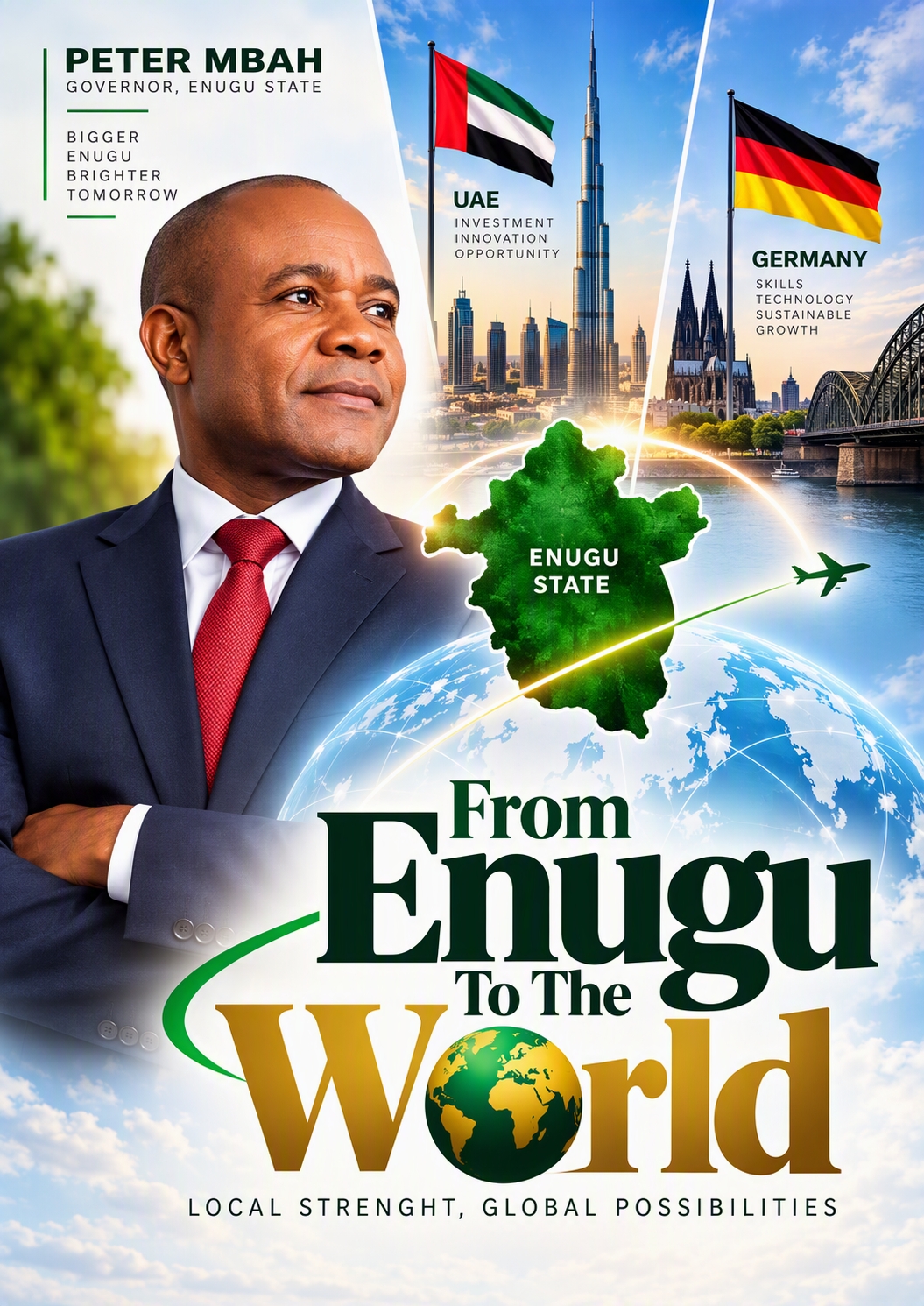
At the centre of that ambition is Governor Peter Ndubuisi Mbah, who assumed office on 29 May 2023 with a declared objective of moving the state’s economy from an estimated $4.4 billion to at least $30 billion within four to eight years.
The distance between those two figures is enormous. The question, therefore, is unavoidable:
How long before the old Coal City becomes a modern industrial state?
How long? Not long, if ambition is matched by execution.
How long? Not long, if infrastructure becomes production.
How long? Not long, if public investment produces private enterprise.
A City Built by Industry
Modern Enugu did not emerge by historical accident. It grew because coal, railways, labour and administration converged in one location. Its original economic logic was industrial.
Coal created employment. The railway connected production to markets. Workers generated demand for housing, food and services. Traders arrived. Neighbourhoods expanded. Government institutions followed.
Yet the colonial economy was designed principally to extract and transport raw materials, not to establish a diversified industrial society owned and directed by the people. The infrastructure served the mine, while the mine served an external market.
That is the central historical difference confronting the present administration. The new roads, schools, water systems, transport terminals, hospitals, aviation projects and commercial districts must not become isolated monuments. They must form a connected economic system.
For Enugu to industrialise, a road must lead to a farm, factory, market or tourism asset. A school must develop productive skills. An airport must move passengers and cargo. A water scheme must serve households and lower the operating burdens of business.
This interconnectedness is a defining feature of Governor Mbah’s development argument.
Speaking to editors in October 2026, the governor said the administration’s investments in security, transport, tourism and other areas were designed to reinforce one another and support the common objective of creating a place where people can live, work, invest and build their futures.
The Mbah Leadership Model:
The emerging Peter Mbah leadership model can be understood through five principles: scale, urgency, interconnection, private-sector participation and human-capital development.
- Governing at the scale of the problem:–
The administration has chosen goals that are deliberately larger than the incremental traditions of state government. The $30 billion economic target is the clearest example. The plan is not merely to improve the existing economy, but to alter its structure by making Enugu a preferred destination for investment, business, tourism and living.
That ambition is also visible in the proposed spread of Smart Green Schools and Type-2 primary healthcare facilities across the state’s 260 electoral wards.
In April 2024, the government said it was constructing 260 schools and 260 primary healthcare facilities, while establishing a monitoring structure intended to oversee quality, cost and timely delivery.
The scale matters because industrialisation cannot be sustained by infrastructure concentrated only within the capital. It requires healthier communities, productive rural populations and young people prepared for technical and digital work.
- Treating time as an economic resource:–
The administration’s political vocabulary repeatedly emphasises deadlines, speed and measurable delivery.
The first major test was water. In November 2023, Mbah inaugurated the Ninth Mile scheme, with a stated production capacity of 70 million litres a day. The administration also said the Oji River scheme could add 50 million litres, bringing total installed production capacity for the metropolis and surrounding areas to 120 million litres daily.
Production capacity, however, is not the same as reliable household delivery. A later assessment reported that ageing distribution infrastructure continued to limit supply in some communities, notwithstanding the rehabilitation of the production schemes.
This distinction is important. A leadership model defined by urgency must also be judged by the last mile: whether water leaves the plant, moves through sound pipes and reaches homes and businesses consistently.
How long must production rise while taps remain dry in some neighbourhoods?
Not long, if distribution receives the same urgency as generation.
3. Building connected economic infrastructure:
The administration’s road programme illustrates its attempt to connect physical construction to productive opportunity.
In May 2026, Mbah inspected the 40-kilometre Owo–Ubahu–Amankanu–Umualor–Neke–Ikem dual carriageway and the 14.5-kilometre Amechi Idodo–Oruku–Amagunze Road, alongside the New Enugu Smart City and Enugu International Hospital. The state government presented the longer road as a new northern gateway and a means of connecting communities and agricultural land to markets.
This is the proper economic test of infrastructure. Kilometres of asphalt are not industrialisation by themselves. Their value lies in reduced travel time, lower logistics costs, improved access to farmland and the commercial activities they make possible.
The same logic applies to the planned International Motor Spare Parts and Allied Trades Park along the Enugu–Onitsha corridor.
In March 2025, the governor signed an executive order relocating relevant commercial and industrial activities from Coal Camp to the new site traversing Udi and Ezeagu local government areas. The proposed facilities included a clinic, fire service, truck park and nearby residential areas. If completed transparently and managed with traders rather than merely for them, the project could make the historic Coal Camp economy part of a more organised commercial and light-industrial ecosystem.
4. Using government to attract private capital:
One of the administration’s clearest departures from conventional state-led development is its reliance on partnership and private-sector participation. The federal government formally handed Akanu Ibiam International Airport to Aero Alliance Limited under a public-private partnership in June 2026. Under the cited agreement, the concessionaire is responsible for financing, rehabilitating, expanding, operating and managing the airport. Federal officials credited the Enugu administration with presenting a plan to develop the state as an aviation and investment hub.
This approach reflects an important reality. No state can finance industrial transformation from public revenue alone. Government must provide credible rules, security, infrastructure and institutional continuity that persuade private investors to risk capital.
But private participation is not a substitute for public accountability. Concessions must be transparent. Public assets must not become private monopolies. Performance obligations, worker protections and service standards must be measurable.
The leadership lesson is therefore two-sided: government should not attempt to operate every enterprise, but neither should it surrender its duty to protect the public interest.
5. Placing human capital inside the industrial strategy:
Factories are built with concrete and machinery, but industrial economies are built by the people.
In its education policy, Governor Peter Mbah’s administration has allocated approximately one-third of the state budget to the sector. In September 2025, Mbah explained that the Smart Green Schools were intended to combine digital classrooms, ICT centres, robotics and artificial-intelligence laboratories, electronic libraries, renewable energy and agricultural learning.
The model attempts to replace rote learning with experiential education, linking the classroom to problem-solving, technology, agriculture and future employment.
In November 2024, the governor described experiential learning as a connection between education, industrialisation and economic growth. This may be the administration’s most consequential wager.
Industrial parks can be completed within political cycles. Human capital takes longer. If the schools succeed, their deepest economic returns may emerge after the leaders who commissioned them might have left office.
How long before every school building matches the promise behind it?
Not long, if quality is treated as seriously as speed. Not long, if monitoring is public and contractors are held accountable.
These concerns do not invalidate the policy’s ambition. They underline the obligation to publish inspection results, enforce contracts and place children’s safety above the political pressure to commission projects quickly.
From Coal Trains to Flight Routes:
There is historical symmetry in the present moment.
A century ago, the railway connected Enugu’s coalfields to an external economy. Today, Mbah’s administration is building roads, aviation services, industrial districts and digital learning systems that connect the state to national and international markets.
On 23 September 2026, the state government reported the flag-off of an Enugu Air international service to Douala. The wider aviation programme, including the airport concession, is being presented as a platform for passenger travel, cargo, logistics, tourism and investment.
The promise is considerable, but success cannot be measured simply by aircraft bearing the state’s name. It must eventually be measured by passenger volumes, cargo moved, reliability, commercial viability, jobs created and the number of local businesses reaching new markets. That is the difference between symbolism and industrial policy and Governor Peter Ndubuisi Mbah is matching words with action.
In September 2026, the administration unveiled a proposed 25-year development plan intended to guide long-term investment, strengthen institutions and sustain programmes beyond a single administration. The government said the plan would align investments in infrastructure, human capital and public services with measurable, enduring development outcomes. This may ultimately prove more important than any flyover, terminal or flagship school.
The lasting test of the Mbah’s model will be whether it creates institutions that function without constant direction from the governor. Can water systems be maintained? Can schools keep qualified teachers? Can hospitals retain professionals? Can industrial districts secure power and transport links? Can the state publish credible accounts and performance results? Can succeeding administrations continue useful projects rather than abandon them? Leadership becomes transformational only when it turns personal urgency into institutional habit.
How Long, Not Long:
How long before the memory of coal becomes the foundation of a new productive economy?
Not long, if Enugu remembers that it was industry, transportation and labour that first gave the city national importance.
How long before young people can build meaningful careers without leaving the state?
Not long, if the investment in education produces competence, enterprise and employment, rather than buildings alone.
How long before farms become agro-industrial value chains, markets become organised commercial ecosystems, and roads become corridors of production?
Not long, if infrastructure is planned as one connected economic network.
How long before Enugu takes its place before the world?
Not long, if aviation moves goods as well as dignitaries. Not long, if water reaches the household as well as the commissioning plaque. Not long, if public-private partnerships serve the public as well as the investor. Not long, if speed walks beside quality, and ambition walks beside accountability. That’s exactly what Mbah’s leadership mantra stands to accomplish.
But history teaches a final lesson:
Coal did not make Enugu great merely because it lay beneath the earth. It had to be discovered, mined, transported and converted into economic power. In the same way, today’s vision will not transform the state simply because it appears in the budgets, speeches and architectural designs.
It must be executed.
It must be maintained.
It must be measured.
It must include the people.
That is the promise and the burden of the Peter Mbah leadership model: to govern with the urgency of enterprise, the scale of history and the discipline of measurable results. The old Enugu sent coal to the world. The new Enugu seeks to send knowledge, commerce, culture, technology, food, manufactured products and opportunity.
How long? Not long, if the work continues.
Not long, if the people remain the purpose.
Not long, if tomorrow is built to endure.
Enugu State is heading for greatness.
Invest in Enugu. Invest in the Future. The South-East Economic Superhighway is here.
Tomorrow Is Here.
Prince Humphrey Onyima, Special Adviser to the Governor of Enugu State on Investment Strategy and Public Relations, Government House Enugu, Nigeria. 11th October, 2026.