_By Ogona Anita,
October 14, 2026
The Niger Delta Progressive Alliance (NDPA) has endorsed President Bola Ahmed Tinubu for a second term in office ahead of the 2027 presidential election.
The group also called on the Federal Government to increase the derivation allocation received by oil-producing states from the current 13 per cent to 25 per cent.
The NDPA said its endorsement was based on what it described as President Tinubu’s willingness to make difficult decisions and implement reforms. According to the group, the President has demonstrated the political courage required to address some of the longstanding demands of the Niger Delta region.
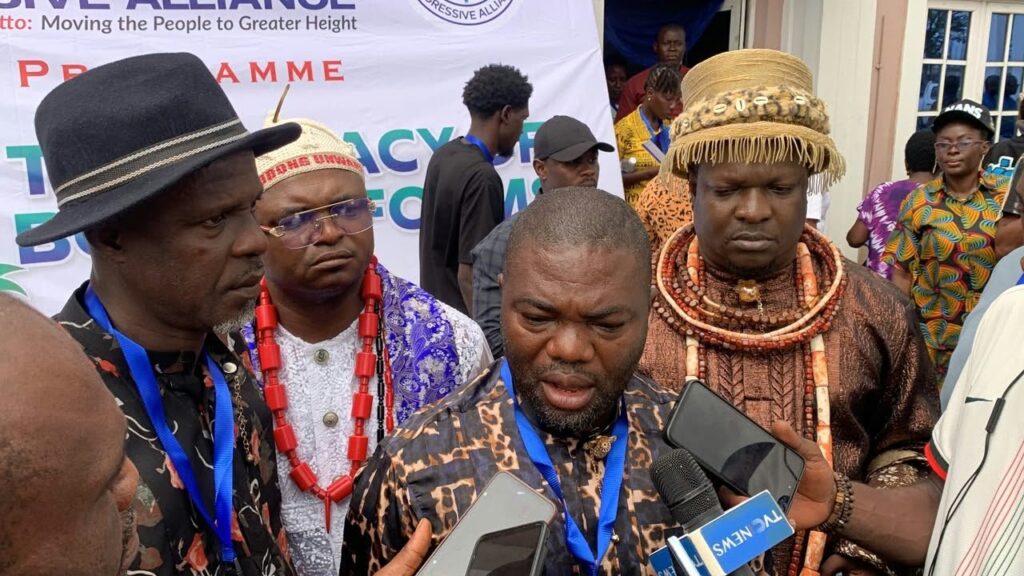
The convener of the NDPA, Ambassador Nse Victor Udoh, announced the endorsement during an event organised by the group in Bayelsa State to commemorate Nigeria’s 66th Independence anniversary.
The event was held under the theme, “The Legacy of Bold Reforms: Evaluative Review of the Tinubu Reforms in Three Years in Relation to the Quest for Sustainable Development for Niger Deltans.”
Udoh said the people of the Niger Delta were demanding an increase in the derivation formula because of the region’s contribution to Nigeria’s oil wealth. He acknowledged that raising the allocation from 13 per cent to 25 per cent would require a major political decision.
According to him, the alliance assessed the leading candidates expected to participate in the forthcoming presidential election and concluded that Tinubu possessed the boldness needed to consider such a demand.
“The Niger Delta people are asking for the increase of our resource derivation formula from 13 per cent to 25 per cent, and we know that it is a difficult decision to take,” Udoh said.
He added that the group’s position was informed by the President’s decisions since assuming office, particularly the removal of the fuel subsidy.
“We have looked at the three frontline candidates in the forthcoming election, and we think that Bola Ahmed Tinubu, with the boldness he has displayed and the tough decisions he has taken, including the removal of the fuel subsidy, is the one who can align with this kind of decision,” he stated.
Udoh said the endorsement was moved by the Bayelsa State coordinator of the alliance and received the support of participants at the gathering.
He described the NDPA as a community-based organisation with links to people at the grassroots across the Niger Delta. He said the group’s members had expressed support for the President’s reforms and his anticipated candidacy in the 2027 election.
According to the convener, the endorsement was based on two principal considerations: the group’s confidence in Tinubu’s capacity to undertake difficult reforms and the fact that First Lady Senator Oluremi Tinubu is regarded by the alliance as a daughter of the Niger Delta region.
Udoh argued that the removal of the fuel subsidy had increased the funds available to various levels of government for infrastructure and development projects. He maintained that the President’s record in office offered voters a basis on which to assess his leadership.
“Niger Delta people are interested in reality, and the reality that has guaranteed the availability of funds for infrastructural development is what we will support,” he said.
He added that while other prospective candidates might be making promises about what they would do if elected, Tinubu had already demonstrated his approach to governance through decisions taken in office.
“This President has demonstrated what he can do through tough decisions, and those tough decisions are what will guarantee the development of our country,” Udoh said.
The NDPA convener expressed confidence that voters in the Niger Delta would give the President substantial support in 2027. He also predicted that the region would deliver one of Tinubu’s highest vote totals during the election.
Udoh said the alliance was establishing structures across the Niger Delta to canvass support for the President. According to him, the organisation intends to extend its mobilisation activities to communities throughout the region.
Stakeholders Highlight Federal Projects
Another speaker at the event, Chief Jato Abido, said Nigerians had long understood many of the country’s problems but often lacked the political courage to make the difficult decisions required to address them.
Abido argued that the Tinubu administration’s economic decisions had resulted in increased funds for state governments, including those in the Niger Delta. He said the additional resources should enable governors to undertake more development projects.
He also identified initiatives and projects in the region which he associated with the Tinubu administration. These included support for the Presidential Amnesty Programme, the establishment of the Federal University of Environment and Technology in Ogoniland, the ongoing clean-up of Ogoni communities by the Hydrocarbon Pollution Remediation Project, and the completion of the Bonny-Bodo Road.
Students Praise Education Loan Initiative:
The chairman of the National Association of Nigerian Students Joint Campus Council in Bayelsa State, Comrade Lucky Michael, commended the Federal Government’s student loan initiative.
Michael said the Nigerian Education Loan Fund had created opportunities for students who might otherwise have been unable to continue their education because of financial difficulties.
According to him, some students previously had to withdraw from school because they could not afford their tuition and other approved charges. He said the loan scheme had given such students greater hope of completing their studies.
The student leader, however, appealed to the Federal Government and the agencies responsible for administering the programme to address delays affecting some applicants. He said certain students who had applied for assistance were still unable to access the funds, creating difficulties for those whose institutions required payment before they could participate in examinations.
“We are grateful to the Federal Government for this initiative to empower Nigerian students, and we appeal that it should continue and be sustained,” Michael said.
“The delays affecting those who have applied should also be addressed because some schools do not allow students to write examinations when their fees have not been paid.”
NDPA Rejects Return of Fuel Subsidy:
Addressing the continuing debate over the removal of the fuel subsidy, Udoh said the NDPA opposed its reinstatement.
He alleged that the former subsidy system was vulnerable to extensive fraud and maintained that the alliance had consistently supported its removal.
“We reject the return of the fuel subsidy because of the massive fraudulent process associated with it. We supported subsidy removal during the administration of President Goodluck Jonathan, and our position has not changed,” Udoh said.
The NDPA maintained that while the President’s reforms had imposed difficult adjustments, tough policy choices were necessary to create the financial foundation for infrastructure and national development.
At the same time, the alliance restated its demand for a higher derivation allocation, insisting that oil-producing communities and states should receive 25 per cent rather than the current 13 per cent.