
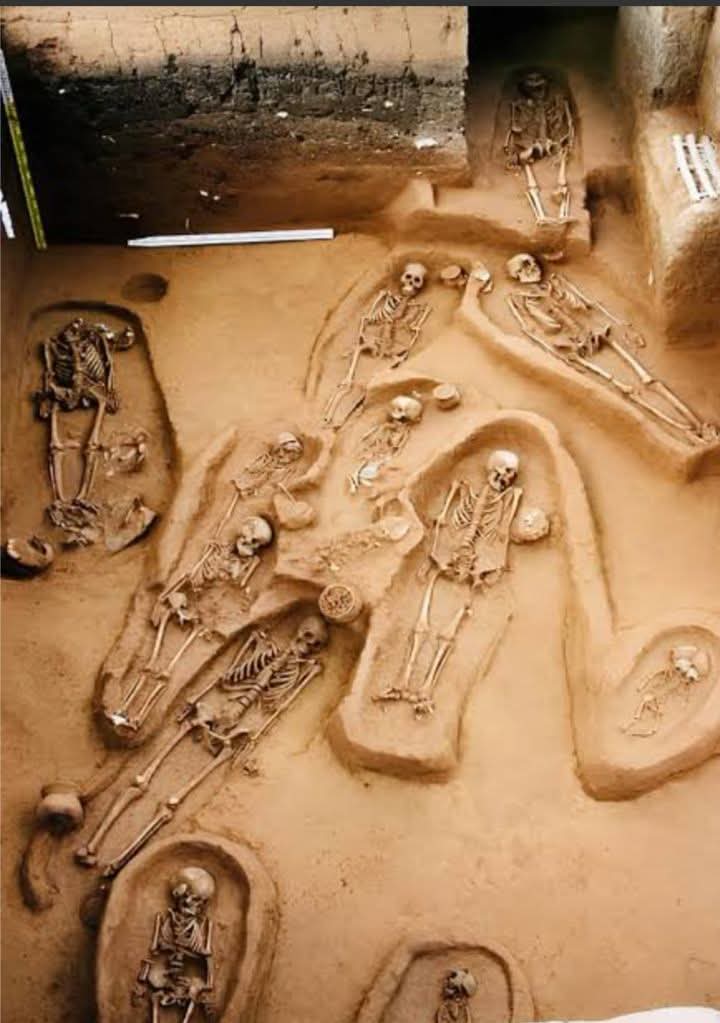
ISARUN, ONDO STATE — Near the community of Isarun in Ondo State lies Iho Eleru, a rock shelter whose archaeological record reaches back thousands of years.
Its Yoruba name is commonly translated as “cave of ashes.” Formerly published as Iwo Eleru, the site has yielded Later Stone Age tools, plant remains, pottery, animal remains and one of the oldest known human burials discovered in West Africa.
Excavations led by archaeologist Thurstan Shaw and his team in the 1960s recovered more than half a million artefacts, according to subsequent archaeological accounts. The discoveries provide a rare window into human life in the forest and savanna environments of southwestern Nigeria.
Although the site is located in an area now inhabited largely by Yoruba-speaking communities, archaeologists have not established that its earliest occupants identified themselves as Yoruba. The settlement and burial evidence at Iho Eleru predate written Yoruba history and the emergence of known Yoruba kingdoms by many thousands of years.
Stone tools and the work of survival
Stone artefacts form the largest category of material recovered from Iho Eleru. They include tools associated with cutting, scraping and other everyday activities.
The presence of numerous scrapers has encouraged suggestions that some occupants may have used stone tools to prepare animal hides. Such hides could have served practical purposes, including coverings, bedding or containers. However, the available evidence does not conclusively establish that the shelter functioned as a specialised or permanent leather-processing workshop.
A more cautious interpretation is that the tools reflect a community skilled in processing the resources available in its environment. Hunting, food preparation, woodworking, hide treatment and the production of useful objects would all have been important aspects of survival.
The discoveries nevertheless reveal technological knowledge and careful adaptation to local conditions. They also offer an opportunity to examine the long history of craft production in a region where leather, wood, fibre and other natural materials remain important to artisans.
Early evidence of plant use
Plant remains recovered from the site are among its most important archaeological discoveries.
Evidence associated with Canarium schweinfurthii, a tree commonly known as the African elemi or bush candle tree, has been dated to about 11,300 years before the present. Archaeological summaries describe it as among the earliest evidence of the plant’s exploitation in West Africa.
The discovery suggests that the people who used the shelter possessed detailed knowledge of surrounding plant resources. They understood which fruits, nuts, oils, wood and other materials could be collected and used.
Later deposits also indicate continued reliance on the surrounding environment. Taken together, the evidence presents Iho Eleru not as an isolated cave but as part of a wider landscape in which people moved, gathered food, hunted and processed natural materials.
Pottery and a changing site
Pottery appeared in the later phases of occupation at Iho Eleru. Its presence indicates that the ways in which people used the shelter changed over time.
Archaeologists also recovered animal remains and other materials associated with subsistence. These finds point to a community that drew on several food sources and continued to use the shelter across different periods.
Pits, grave features and terracotta materials have led researchers to consider whether parts of the site later acquired social or ceremonial importance.
However, such evidence must be interpreted carefully. It does not, by itself, confirm claims about human sacrifice, divination systems or any specific ritual practice.
The burial that changed scientific understanding
The site’s best-known discovery is a fragmentary human skeleton found in a shallow grave during the 1965 excavation.
Contrary to some popular retellings, published archaeological accounts describe it as a contracted burial rather than a person buried standing upright. The available scientific descriptions also do not support the claim that the individual was holding two clay pots.
The burial is important not because it proves a sacrificial practice, but because of its age and the unusual form of the skull.
A 2011 study led by palaeoanthropologist Katerina Harvati used three-dimensional analysis to compare the skull with fossil and modern human specimens.
Uranium-series dating placed the remains within an estimated range of about 11,700 to 16,300 years old.
The study found similarities between the skull and some Late Pleistocene African specimens described as having relatively archaic features. Its authors said the findings pointed to a complex history of human populations in Africa and highlighted how little is still known about human evolution in West Africa.
The precise identity of the individual remains uncertain. Researchers have also not established the cultural meaning of the burial or the circumstances surrounding the person’s death.
For that reason, describing the individual as a sacrificial victim would go beyond the available evidence.
A history older than kingdoms
The importance of Iho Eleru does not depend on dramatic claims.
Its archaeological record documents people making tools, gathering plants, processing animals and returning to the shelter across a long period. The burial provides rare evidence of a human population living in West Africa toward the end of the Pleistocene.
This history is older than surviving royal lists, written chronicles and modern ethnic identities. Yet it belongs to the wider heritage of the communities that live around the site today, as well as to Nigeria, Africa and the global scientific community.
The site also reminds us that the history of southwestern Nigeria did not begin with palaces, crowns or written records. Long before the rise of known kingdoms, people were already developing technologies, understanding their environment and establishing relationships with the landscape.
Protecting a site of international importance
Despite its scientific value, Iho Eleru is not as widely recognised as many other major African archaeological sites.
The National Commission for Museums and Monuments, the Ondo State Government, universities and the local community should consider a coordinated conservation and research programme for the site.
Such a programme could include:
•formal assessment of the shelter’s present condition;
•stronger legal and physical protection;
•controlled and responsible visitor access;
•renewed archaeological and environmental research;
•professional conservation of recovered materials;
•educational programmes for schools and visitors;
•training and employment opportunities for members of the host community; and
•a modest interpretation centre developed in consultation with local residents.
Any tourism initiative should place conservation ahead of commercial activity. It should also recognise the community surrounding the site as a central partner rather than a passive observer.
More questions beneath the surface
Many questions about Iho Eleru remain unanswered.
Who were the ancient people who used the shelter? How did their communities move across the region? What animals and plants sustained them? How did their technologies change? And how many comparable sites remain undiscovered across Ondo State and other parts of Nigeria?
Answering those questions will require additional research, careful conservation and collaboration among archaeologists, government institutions and local communities.
What is already known is significant: Iho Eleru preserves an exceptional record of human life in West Africa. Its story should be told accurately, protected responsibly and studied without unnecessary embellishment.
The evidence itself is remarkable enough.
Ire o.
Alex Sewo
References
- Shaw, Thurstan, and S. G. H. Daniels. “Excavations at Iwo Eleru, Ondo State, Nigeria.” West African Journal of Archaeology, vol. 14, 1984, pp. 1–269.
- Harvati, Katerina, Chris Stringer, Rainer Grün, Maxime Aubert, Philip Allsworth-Jones and Caleb Adebayo Folorunso. “The Later Stone Age Calvaria from Iwo Eleru, Nigeria: Morphology and Chronology.” PLOS ONE, vol. 6, no. 9, 2011, e24024.
- Allsworth-Jones, Philip, et al. “The Archaeological Context of the Iwo Eleru Cranium from Nigeria and Preliminary Results of New Morphometric Studies.”
- Stojanowski, Christopher M. “Iwo Eleru’s Place among Late Pleistocene and Early Holocene Populations of North and East Africa.” Journal of Human Evolution, vol. 75, 2014.
Recommended headline alternatives - Iho Eleru: The Ancient Ondo Rock Shelter Rewriting West Africa’s Human Story
- Inside Iho Eleru, Where Evidence of Early Human Life Survived for Thousands of Years
- Beyond Kings and Kingdoms: What Iho Eleru