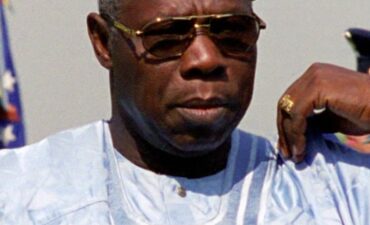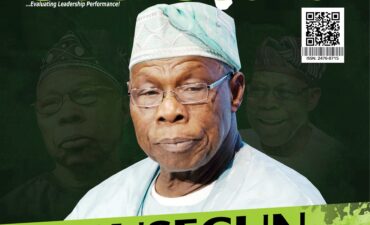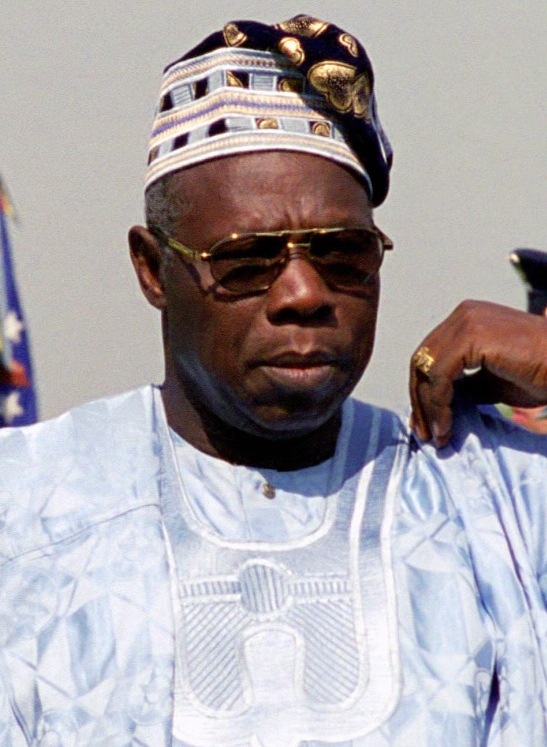
Chief Olusegun Obasanjo turns 89 on the 5th of March 2026. Through this piece, Leadership Scorecard celebrates the birthday anniversary of a General of War – “The Balogun of Owu Kingdom”, a soldier and prisoner of conscience, president and peacemaker, who has occupied more consequential roles in African public life than any other figure of his generation. From Abeokuta to National Consciousness. Born on 5th March 1937 in Abeokuta into a Yoruba farming family. Olusegun Obasanjo enlisted into the Nigerian Army in 1958 — a year before independence. He rose quickly, attending officer training at Mons Officer Cadet School in Aldershot and returning to serve through a succession of operational postings. By 1969 he commanded the 3rd Marine Commando Division in the final phase of the civil war. On 15 January 1970, it was Obasanjo who received the formal instrument of surrender from the Biafran high command, ending 30 months of conflict that killed an estimated one million people and displaced millions more. The moment fixed his name in national consciousness before most contemporaries had held senior rank, and it gave him an authority — the authority of a man who had closed a wound — that no appointment could have conferred.
That episode also introduced him to the full weight of state failure and its human cost. He carried that knowledge into every subsequent role, and it shows in the consistency with which, across five decades, he addresses situations of conflict rather than retreating from them.
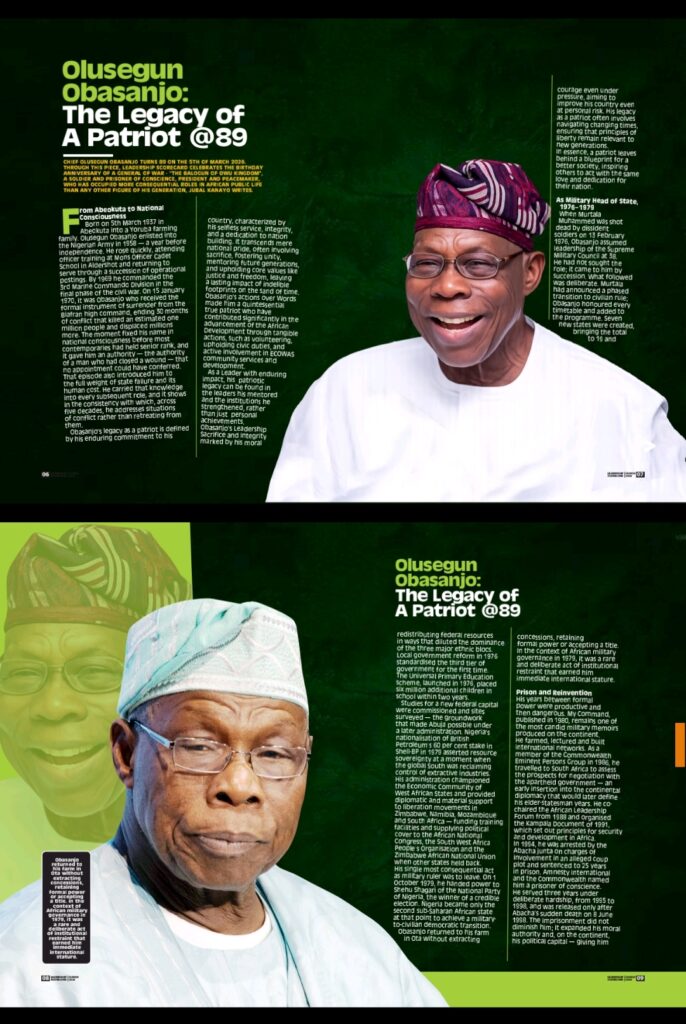
Obasanjo’s legacy as a patriot is defined by his enduring commitment to his country, characterized by his selfless service, integrity, and a dedication to nation building. It transcends mere national pride, often involving sacrifice, fostering unity, mentoring future generations, and upholding core values like justice and freedom, leaving a lasting impact of indelible footprints on the sand of time.
Obasanjo’s actions over Words made him a quintessential true patriot who have contributed significantly in the advancement of the African Development through tangible actions, such as volunteering, upholding civic duties, and active involvement in ECOWAS community services and development.
As a Leader with enduring impact, his patriotic legacy can be found in the leaders his mentored and the institutions he strengthened, rather than just personal achievements.
Obasanjo’s Leadership Sacrifice and Integrity marked by his moral courage even under pressure, aiming to improve his country even at personal risk. His legacy as a patriot often involves navigating changing times, ensuring that principles of liberty remain relevant to new generations.
In essence, a patriot leaves behind a blueprint for a better society, inspiring others to act with the same love and dedication for their nation.
As Military Head of State, 1976–1979
When Murtala Muhammed was shot dead by dissident soldiers on 13 February 1976, Obasanjo assumed leadership of the Supreme Military Council at 38. He had not sought the role; it came to him by succession. What followed was deliberate. Murtala had announced a phased transition to civilian rule; Obasanjo honoured every timetable and added to the programme. Seven new states were created, bringing the total to 19 and redistributing federal resources in ways that diluted the dominance of the three major ethnic blocs. Local government reform in 1976 standardised the third tier of government for the first time. The Universal Primary Education scheme, launched in 1976, placed six million additional children in school within two years.
Programs for a new federal capital were commissioned and sites surveyed — the groundwork that made Abuja possible under a later administration. Nigeria’s nationalisation of British Petroleum’s 60 per cent stake in Shell-BP in 1979 asserted resource sovereignty at a moment when the global South was reclaiming control of extractive industries. His administration championed the Economic Community of West African States and provided diplomatic and material support to liberation movements in Zimbabwe, Namibia, Mozambique and South Africa — funding training facilities and supplying political cover to the African National Congress, the South West Africa People’s Organisation and the Zimbabwe African National Union when other states held back.
His single most consequential act as military ruler was to leave office on 1st October 1979, he handed power to Shehu Shagari of the National Party of Nigeria, the winner of a credible election. Nigeria became only the second sub-Saharan African state at that point to achieve a military-to-civilian democratic transition. Obasanjo returned to his farm in Ota without extracting concessions, retaining formal power or accepting a title. In the context of African military governance in 1979, it was a rare and deliberate act of institutional restraint that earned him immediate international stature.
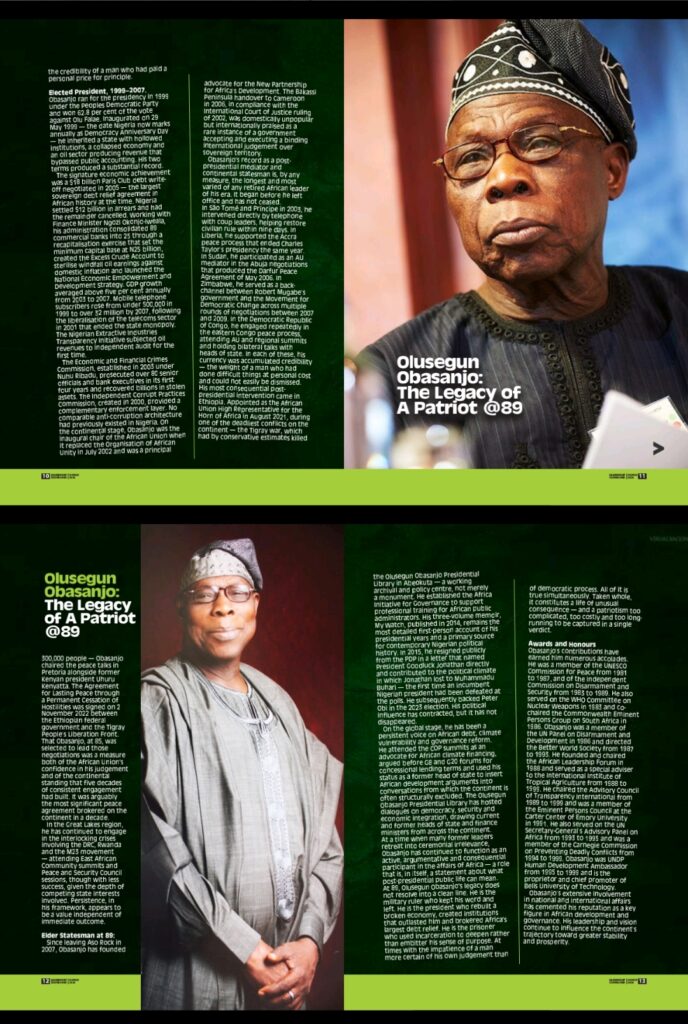
Prison and Reinvention:
Obasanjo’s years between formal power were productive. My Command, published in 1980, remains one of the most candid military memoirs produced on the continent. He farmed, lectured and built international networks. As a member of the Commonwealth Eminent Persons Group in 1986, he travelled to South Africa to assess the prospects for negotiation with the apartheid government — an early insertion into the continental diplomacy that would later define his elder-statesman years. He co-chaired the African Leadership Forum from 1988 and organised the Kampala Document of 1991, which set out principles for security and development in Africa.
In 1994, he was arrested by the Abacha junta on charges of involvement in an alleged coup plot and sentenced to 25 years in prison. Amnesty International and the Commonwealth named him a prisoner of conscience. He served three years under deliberate hardship, from 1995 to 1998, and was released only after Abacha’s sudden death on 8 June 1998. The imprisonment did not diminish him; it expanded his moral authority and, on the continent, his political capital — giving him the credibility of a man who had paid a personal price for principle.
Elected President, 1999–2007.
Obasanjo ran for the presidency in 1999 under the Peoples Democratic Party and won 62.8 per cent of the vote against Olu Falae. Inaugurated on 29 May 1999 — the date Nigeria now marks annually as Democracy Anniversary Day — he inherited a state with hollowed institutions, a collapsed economy and an oil sector producing revenue that bypassed public accounting. His two terms produced a substantial record.
The signature economic achievement was a $18 billion Paris Club debt write-off negotiated in 2005 — the largest sovereign debt relief agreement in African history at the time. Nigeria settled $12 billion in arrears and had the remainder cancelled. Working with Finance Minister Ngozi Okonjo-Iweala, his administration consolidated 89 commercial banks into 25 through a recapitalisation exercise that set the minimum capital base at N25 billion, created the Excess Crude Account to sterilise windfall oil earnings against domestic inflation and launched the National Economic Empowerment and Development Strategy. GDP growth averaged above five per cent annually from 2003 to 2007. Mobile telephone subscribers rose from under 500,000 in 1999 to over 32 million by 2007, following the liberalisation of the telecoms sector in 2001 that ended the state monopoly. The Nigerian Extractive Industries Transparency Initiative subjected oil revenues to independent audit for the first time.
The Economic and Financial Crimes Commission, established in 2003 under Nuhu Ribadu, prosecuted over 80 senior officials and bank executives in its first four years and recovered billions in stolen assets. The Independent Corrupt Practices Commission, created in 2000, provided a complementary enforcement layer. No comparable anti-corruption architecture had previously existed in Nigeria.
On the continental stage, Obasanjo was the inaugural chair of the African Union when it replaced the Organisation of African Unity in July 2002 and was a principal advocate for the New Partnership for Africa’s Development. The Bakassi Peninsula handover to Cameroon in 2006, in compliance with the International Court of Justice ruling of 2002, was domestically unpopular but internationally praised as a rare instance of a government accepting and executing a binding international judgement over sovereign territory.
Obasanjo’s record as a post-presidential mediator and continental statesman is, by any measure, the longest and most varied of any retired African leader of his era. It began before he left office and has not ceased.
In São Tomé and Príncipe in 2003, he intervened directly by telephone with coup leaders, helping restore civilian rule within nine days. In Liberia, he supported the Accra peace process that ended Charles Taylor’s presidency, the same year. In Sudan, he participated as an AU mediator in the Abuja negotiations that produced the Darfur Peace Agreement of May 2006. In Zimbabwe, he served as a back-channel between Robert Mugabe’s government and the Movement for Democratic Change across multiple rounds of negotiations between 2007 and 2009. In the Democratic Republic of Congo, he engaged repeatedly in the eastern Congo peace process, attending AU and regional summits and holding bilateral talks with heads of state. In each of these, his currency accumulated credibility — the weight of a man who had done difficult things at personal cost and could not easily be dismissed.
His most consequential post-presidential intervention came in Ethiopia. Appointed as the African Union High Representative for the Horn of Africa in August 2021, during one of the deadliest conflicts on the continent — the Tigray war, which had by conservative estimates killed 300,000 people — Obasanjo chaired the peace talks in Pretoria alongside former Kenyan president Uhuru Kenyatta. The Agreement for Lasting Peace through a Permanent Cessation of Hostilities was signed on 2 November 2022 between the Ethiopian federal government and the Tigray People’s Liberation Front.
Obasanjo selected to lead those negotiations was a measure both of the African Union’s confidence in his judgement and of the continental standing that five decades of consistent engagement had built. It was arguably the most significant peace agreement brokered on the continent in a decade.
In the Great Lakes region, he has continued to engage in the interlocking crises involving the DRC, Rwanda and the M23 movement — attending East African Community summits and Peace and Security Council sessions, though with less success, given the depth of competing state interests involved. Persistence, in his framework, appears to be a value independent of immediate outcome.
Since leaving Aso Rock in 2007, Obasanjo has founded the Olusegun Obasanjo Presidential Library in Abeokuta — a working archival and policy centre, not merely a monument. He established the Africa Initiative for Governance to support professional training for African public administrators. His three-volume memoir, My Watch, published in 2014, remains the most detailed first-person account of his presidential years and a primary source for contemporary Nigerian political history. In 2015, he resigned publicly from the PDP in a letter that named President Goodluck Jonathan directly and contributed to the political climate in which Jonathan lost to Muhammadu Buhari — the first time an incumbent Nigerian president had been defeated at the polls. He subsequently backed Peter Obi in the 2023 election. His political influence has contracted, but it has not disappeared.
On the global stage, he has been a persistent voice on African debt, climate vulnerability and governance reform. He attended the COP summits as an advocate for African climate financing, argued before G8 and G20 forums for concessional lending terms and used his status as a former head of state to insert African development arguments into conversations from which the continent is often structurally excluded. The Olusegun Obasanjo Presidential Library has hosted dialogues on democracy, security and economic integration, drawing current and former heads of state and finance ministers from across the continent. At a time when many former leaders retreat into ceremonial irrelevance, Obasanjo has continued to function as an active, argumentative and consequential participant in the affairs of Africa — a role that is, in itself, a statement about what post-presidential public life can mean.
At 89, Olusegun Obasanjo’s legacy does not resolve into a clean line. He is the military ruler who kept his word and left. He is the president who rebuilt a broken economy, created institutions that outlasted him and brokered Africa’s largest debt relief. He is the prisoner who used incarceration to deepen rather than embitter his sense of purpose. At times with the impatience of a man more certain of his own judgement than of democratic process. All of it is true simultaneously. Taken whole, it constitutes a life of unusual consequence — and a patriotism too complicated, too costly and too long-running to be captured in a single verdict.